Growing teams
Grow the team without growing the chaos.
What works with eight people starts to break at twenty. Timento gives a growing business the operational structure to add employees, roles and shifts without losing visibility or adding administration.
People and roles, staffing need, planning, daily operations, exceptions, control and insight in one connected flow.
30 days, up to 4 employees, no credit card, personal onboarding.
The moment the small-team system breaks
More people does not have to mean more spreadsheets, messages and management layers.
Small teams run on memory and direct contact. The manager knows who is available, who swapped what and who is close to their contract hours. Growth quietly removes that, one hire at a time. These stages are illustrative, not product limits.
8 people
Everything fits in one head
One manager remembers availability, shifts, changes and who owes whom a favour. A spreadsheet and a group chat are genuinely enough.
- Availability is remembered, not recorded
- Changes travel by message
- Hours are checked person by person
20 people
The pieces start colliding
Roles, leave, shift swaps, contract hours, exceptions and messages now overlap. Every change touches something else, and the manager becomes the bottleneck for all of it.
- Two versions of the schedule are circulating
- Leave and swaps arrive through four channels
- Overtime shows up after the period is closed
40 or more
Several people manage the same workforce
Departments, sites or shifts each have someone in charge. They need shared visibility and the same routines, not private spreadsheets that disagree with each other.
- Managers plan without seeing each other's decisions
- Routines differ per shift and per team
- Nobody owns the operational picture
Structure is what lets a growing business keep moving at speed.
The numbers above are growth stages, not limits in Timento. The point is the shift from remembering to recording, and from personal habits to shared structure.
Build structure around people and roles
Know who works here, what they can do and when they are available.
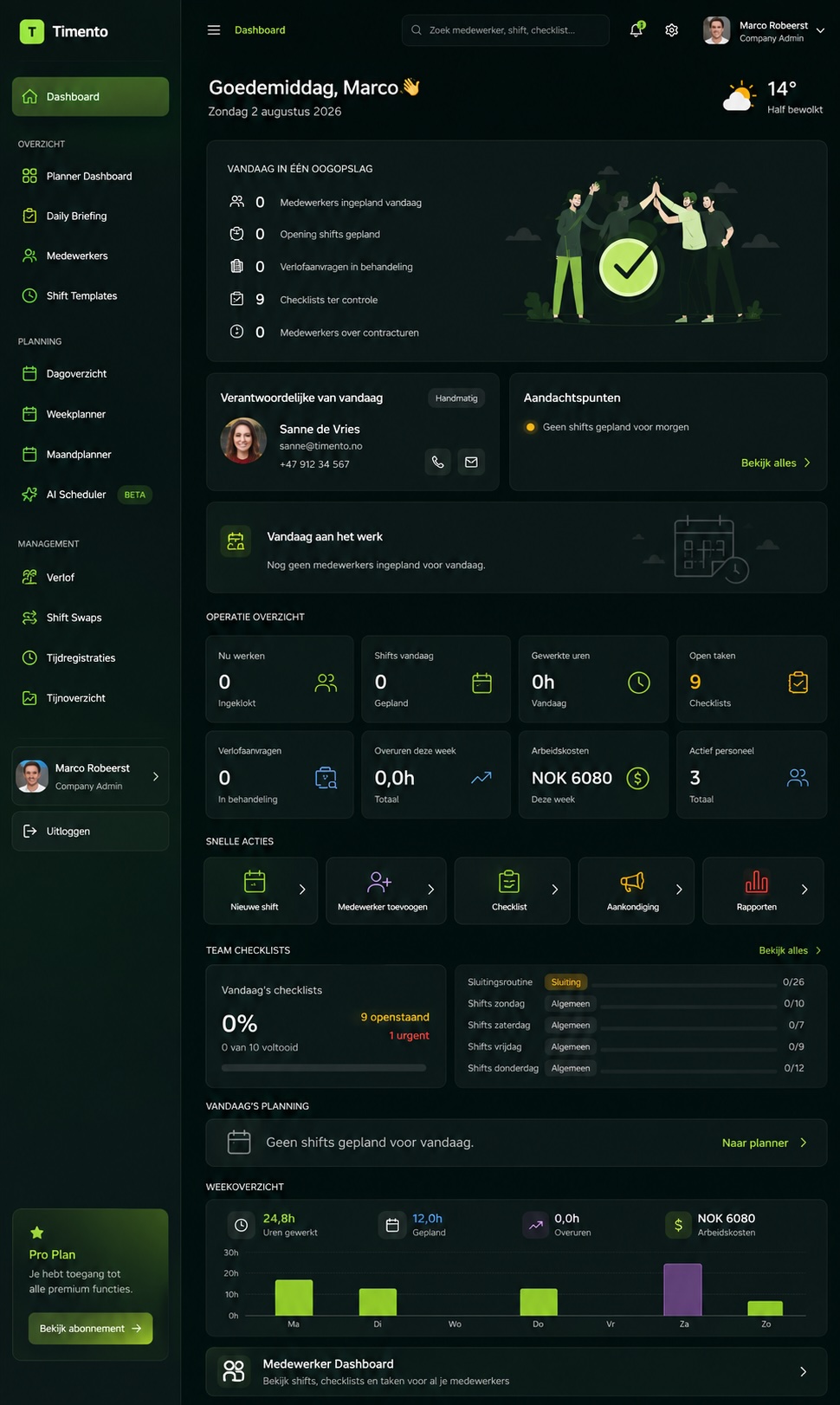
Growth turns people administration from a mental note into a real dataset. Timento keeps employee information, roles, skills, availability and leave in one place, so planning starts from facts instead of recollection.
Employee profiles
Contact details, contract information, employment data and documents in one record per person.
Job Roles
Define the roles your operation actually runs on, and assign people to the roles they can cover.
Role assignments
One person can carry several roles, so a flexible employee stays visible for every shift they can fill.
Availability
Employees keep their own availability windows current, and planners see them while building the week.
Leave
Requests, approvals and balances in one flow, visible in the schedule instead of in a separate list.
Contract hours
Planned hours against contracted hours per person, so growth does not quietly create structural overtime.
Skills and Certifications
At twenty or forty people, no manager can hold the full skills map in their head. Timento records who is trained or certified for what, with validity dates, so you can see which qualifications are valid, which are expiring and which roles are thin on cover before you plan around them.
Timento gives you visibility over recorded skills and certification dates. It does not certify anyone and does not guarantee regulatory compliance on your behalf.
Explore People Management- Valid, ready to be planned
- Expiring soon, plan a refresh
- Expired, not counted as cover
- In training, building toward the role
- Role coverage per team, visible at a glance
Plan a larger team without losing the overview
From who is available to what the operation actually needs.
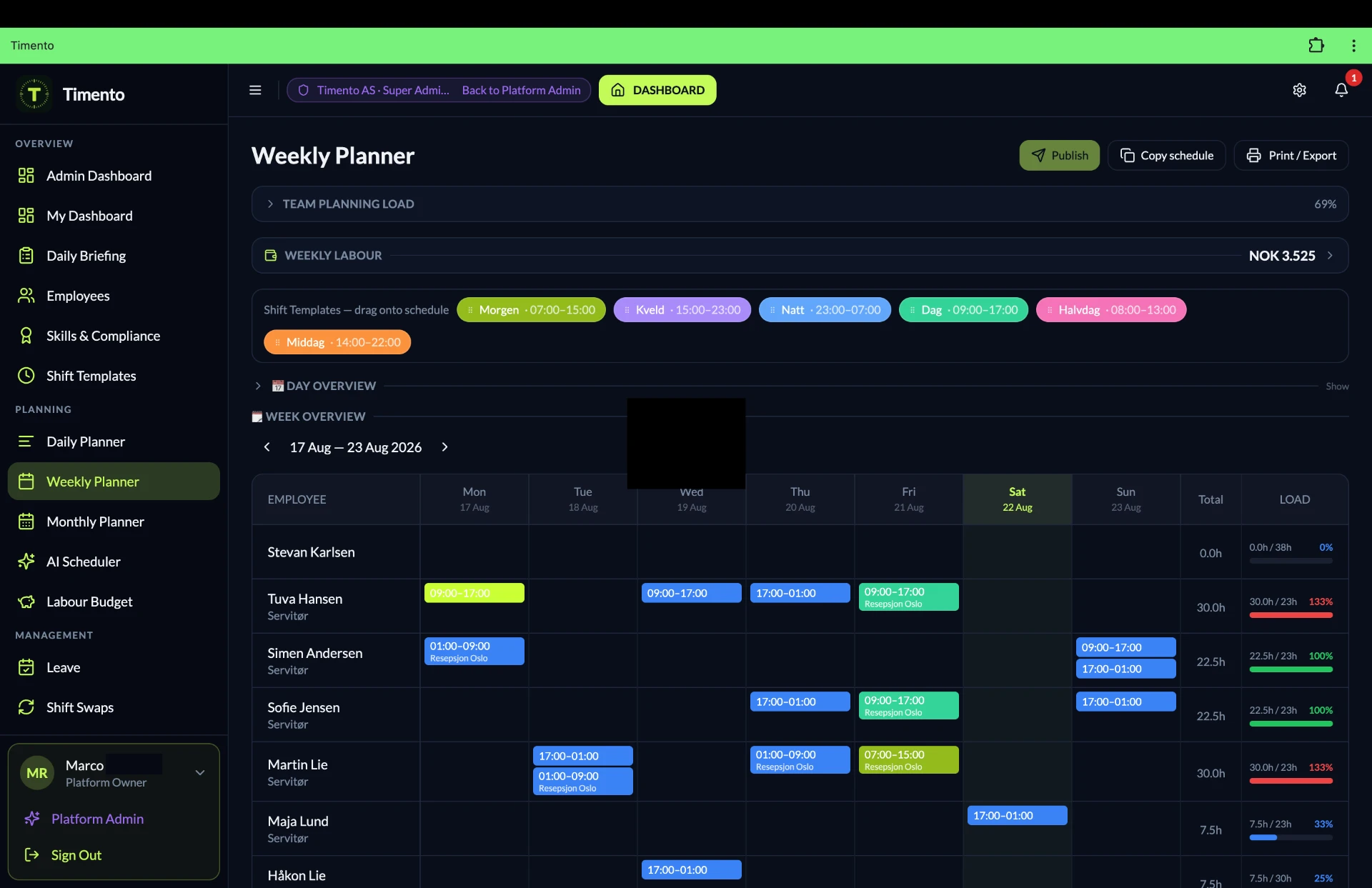
Small-team planning answers one question: who can work. Growing-team planning answers a better one: what staffing does this day require, and does the published schedule deliver it. Smart Scheduling supports both, and Staffing Requirements makes the second one measurable.
Week, day and month views
Zoom from a single day to a full month of coverage without rebuilding your mental model.
Shift templates
Standardise the shifts you run every week, so twenty people are planned as quickly as eight.
Recurring shifts
Fixed patterns repeat automatically and only the exceptions need your time.
Copy schedules
Copy a week or a day forward and adjust what changed, instead of starting from a blank grid.
Role-based shifts
Plan the role the shift needs first, then the person, so cover is visible before names are.
Open shifts
Publish shifts you cannot fill yet and let qualified employees pick them up, with your approval.
Conflict detection
Overlaps, leave clashes, double bookings and missing qualifications are flagged before you publish.
Overtime signals
See where planned hours push past contract hours while there is still time to rebalance.
Publish and notify
One published version reaches everyone at once, so nobody works from an old screenshot.
Required versus scheduled staffing
Set the staffing your operation needs per role and per part of the day, then compare it with what is actually scheduled. Gaps are visible before publishing, not discovered during the shift.
Explore Smart SchedulingExample
| Role | Required | Scheduled | Status |
|---|---|---|---|
| Team lead | 1 | 1 | Covered |
| Front of operation | 4 | 3 | 1 short |
| Support | 2 | 2 | Covered |
| Certified role | 1 | 0 | Gap, open shift |
The result: planning stops being a puzzle of names and becomes a decision about coverage.
Delegate without losing control
Share the operational work, keep the company-level picture.
Growth means the owner can no longer personally handle every schedule change, leave request and operational question. The realistic answer is not working harder, it is letting planners and supervisors take responsibility for their part while the overall picture stays intact.
When everything runs through one person
- Every schedule change waits for one approval
- Leave requests queue up in a private inbox
- Supervisors ask instead of deciding
- Holiday and illness stall the whole operation
- Operational knowledge sits with the owner
With responsibilities shared in Timento
- Planners build and adjust the schedules they are responsible for
- Supervisors handle the day and the exceptions in front of them
- Approvals happen where the context is, not weeks later
- The owner sees the same operational picture without doing the work
- Access matches responsibility, so control is delegated and not lost
Delegation should add capacity, not blind spots.
Access in Timento follows the responsibility someone carries in the operation. You decide who can plan, who can approve and who only sees their own shifts.
Explore the platformEmployee self-service at scale
At twenty people, self-service stops being a convenience.
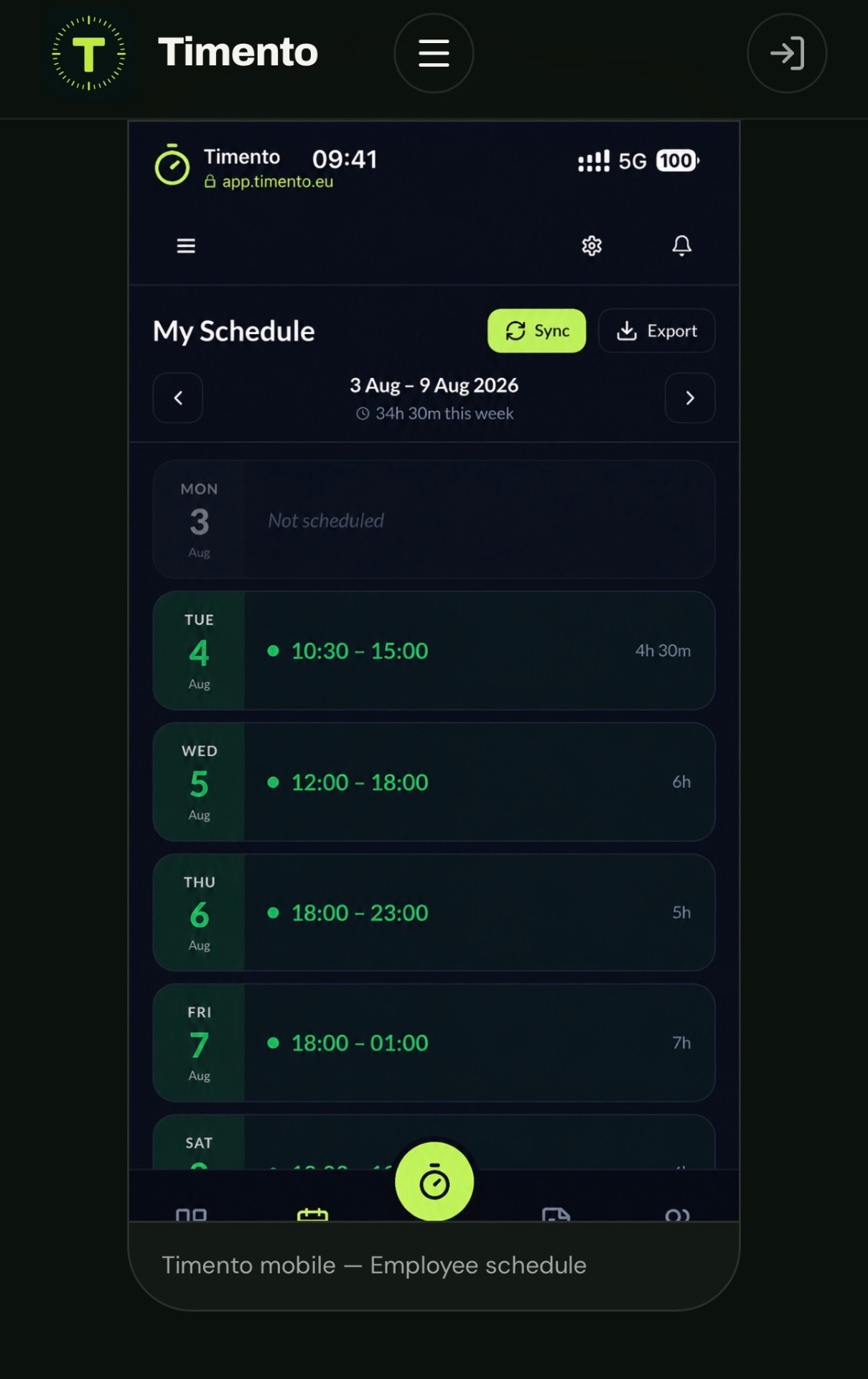
With eight employees a manager can answer every question personally. With twenty or forty, the same questions become a constant interruption. The Employee Portal turns them into something the team resolves on their own phone, inside the rules you set.
- My schedule, always the published version
- Availability employees keep current themselves
- Leave requests submitted and tracked in the app
- Open Shifts qualified employees can pick up
- Shift Swaps proposed between colleagues
- Notifications when something that affects them changes
- Mobile access for a team that is rarely at a desk
- Employee submitsA leave request, an availability change, a swap or interest in an open shift.
- Manager reviewsThe request arrives with the schedule context and staffing impact next to it.
- Approve or declineNothing reaches the published schedule until a manager approves it.
- Team is notifiedThe updated schedule reaches everyone affected, automatically.
Self-service is not self-scheduling. Swaps, leave and open shifts always pass through approval, and publishing stays a management decision.
Time and attendance that stays manageable
Reviewing what needs attention beats checking every timesheet.
Checking forty timesheets line by line is not a growth strategy. Timento records working time while the day happens, flags what looks wrong and gives managers one focused review moment before hours move on.
Clock In, Breaks, Clock Out
Employees register the start, breaks and end of the shift from their phone or a shared device.
Kiosk Mode
A shared tablet at the entrance or in the back office for teams that clock in on site.
Location-based clock verification
Where enabled, a clock action is verified against the configured workplace, so registrations belong to the right site. It verifies the clock action, it does not follow people.
Worked hours
Planned and worked hours side by side, per person, per team and per period.
Exceptions
Missing clock-outs, late starts, long breaks and unusual durations are surfaced instead of quietly passing through.
Review and Approve
Managers correct what needs correcting and approve the rest, so only approved hours continue.
- Clock in
- Breaks
- Clock out
- Exceptions
- Review and Approve
- Payroll ready
Location verification confirms that a clock action happened at the configured workplace. Timento is not an employee tracking system.
Explore Time and AttendanceStandardise how the working day runs
The same routine on every shift, in every team.
When one team becomes three, consistency has to be designed rather than assumed. Timento carries the routines of the working day so a Tuesday evening runs like a Saturday morning, whoever is on shift.
Daily Briefing
Today in short: who is in, what matters, what changed since the last shift.
Operational Checklists
Opening, closing, cleaning and handover routines with a record of who completed what and when.
Handover and Team Updates
What the next shift needs to know, written once instead of explained three times.
Temperature Monitoring
Where relevant to your operation, recorded checks with a timestamp and an owner.
Knowledge Hub
Procedures, house rules and role guidance in one searchable place for every team.
These routines create a record of what was done and by whom. Timento does not provide formal certification and does not replace specialist operational or quality systems.
Communication that scales beyond group chats
One group chat with forty people is not an operating system.
As the team grows, important information competes with everything else in the same thread. Timento keeps three kinds of communication distinct and connects each one to the shift, the task or the person it belongs to.
Messages
Direct and team messages for the practical back and forth of the working day.
Notifications
Automatic updates: a published schedule, an approved leave request, a shift that changed.
Operational Alerts
Signals that something needs a decision, such as a missing clock action, a staffing gap or an unfilled shift.
- Sent to the right peopleA team, a role, a location or a single shift instead of everyone at once.
- Seen and acknowledgedYou can tell that it reached the people it was meant for.
- Action NeededWhen something has to be done, it becomes an item with an owner instead of a hope.
- ResolvedThe item is closed with a record, and the operation moves on.
Timento is not a replacement for Slack or Microsoft Teams. It handles the operational communication that belongs to shifts, tasks and the working day.
Manage by exception
More employees, without proportionally more management administration.
If every extra employee adds inspection work, growth becomes expensive fast. Managers should not review every normal shift, clock action or completed checklist. Timento assumes normal is fine and shows what is not.
Manage the exceptions. Let the normal day run itself.
Which items appear depends on what you use. A team that only plans and clocks will see scheduling and time signals, and can add operational ones later.
- Schedule conflicts before the week is published
- Staffing gaps against required staffing
- Open shifts nobody has picked up yet
- Leave requests waiting for a decision
- Clock exceptions such as a missing clock-out
- Overtime signals against contract hours
- Checklists not completed on a shift
- Operational alerts raised during the day
- OpenSomething needs attention and is visible to the people responsible.
- AcknowledgedSomeone has taken it on, so it stops being everybody's and nobody's problem.
- ResolvedIt is closed with a record of what happened and who handled it.
Control labour cost as headcount grows
Are we adding the right hours, in the right places, for the work we actually need?
At eight employees a scheduling mistake costs a few hours. At forty it repeats every week across teams and shifts. Timento connects the staffing decision to the cost it creates, and then to what was actually worked.
- Staffing Requirements
- Scheduled hours
- Planned labour cost
- Actual worked hours
- Review and Approve
- Planned vs Actual
- Payroll Ready
- Planned labour cost visible while you build the week, not after the period closes
- Contract hours per person, so growth does not create silent structural overtime
- Overtime signals early enough to rebalance the schedule
- Planned versus actual hours per team and per period
- Reports and insights on hours, cost and coverage as the team grows
- Approved hours exported in a payroll-ready format where supported
Small scheduling differences become meaningful cost differences once they repeat across a larger team.
Timento prepares payroll-ready information and exports it where supported. It does not run payroll and does not replace your payroll or accounting system.
Explore Payroll and ReportingFrom one manager to a management team
One operational picture, not five personal spreadsheets.
The moment a second person manages the workforce, the risk is not workload, it is divergence. Two planners with two files will make two different decisions about the same Saturday. Shared visibility is what keeps a management team aligned.
Shared scheduling
Planners work in the same schedule, so a change made by one is immediately visible to the others.
Live Team Status
Who is clocked in, who is late, who is on leave, right now and across teams.
Attention items
The same exceptions, visible to the people responsible instead of only to the owner.
Approvals
Leave, swaps and worked hours approved by the manager closest to the situation.
Handovers
Shift and day handovers recorded, so information survives the change of manager.
Reports and insights
One set of numbers on hours, cost and coverage for the whole management team.
Everyone manages their own part of the operation, from the same picture.
This stays within the roles and responsibilities you configure in Timento. It does not impose an organisational hierarchy on your business.
Knowledge that does not live in one person's head
The fastest way to slow a growing team down is to make everyone ask.
In a small team, the person who knows how things work is always nearby. In a growing one, they are on another shift. Knowledge Hub makes procedures, routines and role information available to everyone who needs them.
Knowledge Hub is a practical internal knowledge base. It is not a learning management system and does not provide formal document control or training certification.
Explore Knowledge Hub- Procedures and standard routines per role or team
- Onboarding material new employees can work through themselves
- House rules and practical day-to-day guidance
- Role information tied to the work someone actually does
- Searchable, so the answer is faster than asking a colleague
- Updated in one place instead of in five printed folders
AI Copilot and Operations Intelligence
A second pair of eyes on an operation that is getting bigger.
With scale comes pattern. Repeating gaps on the same weekday, overtime concentrating in one team, a role that is always thin on cover. AI Copilot looks across your workforce data and points these out, so a manager can decide earlier.
AI Copilot makes suggestions and surfaces signals. It does not publish schedules, approve hours or make workforce decisions on its own. The manager stays in control of every decision.
- Patterns in staffing gaps across weeks and teams
- Overtime building up before it becomes a payroll surprise
- Roles where coverage depends on very few qualified people
- Differences between planned and actual hours worth a closer look
- Opportunities to rebalance a schedule against the required staffing
Ready for the next stage
Growth rarely stops at one location.
The structure you build now should still work when a second site opens or when the organisation gets more layers. Timento continues from a single growing operation into multi-location and larger organisational needs.
Most growing teams do not need enterprise capability yet. The point is that nothing has to be rebuilt when they do.
- One growing teamRoles, planning, time and daily operations in one place for one operation.
- Several teams or departmentsShared visibility and consistent routines across the people who manage them.
- Multiple locationsThe same workforce structure per site, with a picture that spans them.
Pricing for growing teams
Growth is the plan built for this stage.
Growth covers a team that has passed the point where a spreadsheet still works, with the operational control capabilities a larger workforce needs.
Pay annually and get 12 months for the price of 10.
Start with a 30-day trial for up to 4 employees, no credit card required.
Compare all plansGrowth
59 EURper month
- 30 employees included
- Scheduling, time and attendance and leave
- Employee Portal with open shifts and swaps
- Operational control capabilities as listed in the pricing matrix
- Reports and payroll-ready exports where supported
Additional employees: 2 EUR per employee per month.
Request a trialThe connected growth flow
One chain, from who works here to what it cost.
Every step feeds the next, which is exactly what a spreadsheet cannot do. This is the structure that lets headcount grow without the administration growing with it.
- People and Roles
- Staffing need
- Schedule
- Publish
- Employee self-service
- Clock and daily operations
- Exceptions
- Review and Approve
- Labour cost and Payroll Ready
- Management insight
- People and Roles
- Staffing need
- Schedule
- Publish
- Employee self-service
- Clock and daily operations
- Exceptions
- Review and Approve
- Labour cost and Payroll Ready
- Management insight
You do not have to switch all of it on at once. Start with planning and time, and add the operational layers as the team grows into them.
Where Timento fits, and where it stops
Timento is the workforce operations layer of a growing business. It brings people, planning, working time and daily operations together, and connects or exports to the systems around it where supported. It does not replace payroll or accounting software, ERP, POS, booking systems, MES, CRM or specialist industry systems.
See integrationsQuestions & answers
Growing team questions, answered
What changes when a team outgrows spreadsheets, and how Timento keeps it manageable.
When should a growing business move from spreadsheets to workforce software?
Usually around the point where one person can no longer hold the schedule, availability and hours in their head. In practice that starts somewhere between ten and twenty employees, and becomes urgent once several people manage the same workforce. The signal is not headcount but coordination: two versions of the schedule, changes lost in chat, overtime discovered after the period closed.
Can I let managers plan without giving them access to everything?
Yes. Access in Timento follows the responsibility someone carries. Planners can build and adjust the schedules they are responsible for, supervisors can handle the day and the exceptions in front of them, and employees see their own shifts. The company-level picture stays with the people who need it.
How do I keep track of who is qualified for which role?
Skills & Certifications records who is trained or certified for what, with validity dates. You can see which qualifications are valid, which are expiring and which roles have thin cover before you plan around them. Timento gives visibility, it does not certify anyone or guarantee regulatory compliance on your behalf.
What are Staffing Requirements and why do they matter as we grow?
Staffing Requirements let you set the staffing your operation needs per role and per part of the day, then compare it with what is actually scheduled. Planning shifts from who is available to whether the published week delivers the coverage you need. Gaps are visible before publishing instead of during the shift.
Does more employees mean more administration for managers?
Not if you manage by exception. Timento assumes the normal day is fine and surfaces what is not: schedule conflicts, staffing gaps, unclaimed open shifts, leave awaiting a decision, clock exceptions, overtime signals and operational alerts. Items move through Open, Acknowledged and Resolved so responsibility is clear.
How does Timento help control labour cost as headcount grows?
It connects the chain: required staffing, scheduled hours, planned labour cost, actual worked hours, review and approve, planned versus actual, and payroll-ready output. Contract hours and overtime signals show where planned hours drift before the period closes. Small scheduling differences become meaningful once they repeat across a larger team.
We now have several managers. How do we avoid conflicting schedules?
Planners work in the same schedule, so a change made by one is immediately visible to the others. Live Team Status, attention items, approvals and handovers give the management team one operational picture instead of separate personal spreadsheets.
Will employees be able to change their own shifts?
Self-service is not self-scheduling. Employees can keep availability current, request leave, propose shift swaps and show interest in open shifts. Every one of those passes through manager approval, and publishing stays a management decision.
What does Timento cost for a growing team?
The Growth plan is 59 EUR per month and includes 30 employees, with additional employees at 2 EUR per employee per month. Paying annually gives you 12 months for the price of 10. The pricing page shows the full comparison of what each plan includes.
What happens when we open a second location?
The structure carries over. The same roles, planning, time registration and daily routines apply per site, with a picture that spans them. Multi-location and Enterprise solutions continue from there, so nothing has to be rebuilt when you get to that stage.
Is location-based clocking a way of tracking employees?
No. Where enabled, it verifies that a clock action happened at the configured workplace, so registrations belong to the right site. It confirms the clock action itself and does not follow people during or outside their shift.
Does Timento replace our payroll or other business systems?
No. Timento is the workforce operations layer: people, planning, working time and daily operations. It prepares payroll-ready information and exports it where supported, and connects to surrounding systems, but it does not replace payroll or accounting software, ERP, POS, booking systems or specialist industry systems.
Fix the workforce admin before it becomes permanent.
Fragmented workforce administration is easiest to replace while it is still a habit, not yet an institution. See what your operation looks like with one connected structure behind it.
30 days, up to 4 employees, no credit card, personal onboarding.